Monday, August 12, 2013

Fodder and Other Summer Adventures

A whole season has passed me by without a word out there about summer at Haven Ridge.  That is because it is busy and when I sit down to type I'm so tired, the motivation isn't there.  

  We had two crias born this summer, 
 Peninah was born June 11th to our own ReignEllan.
Augustus was born August 3rd to April Snow.

In the mist of these beautiful babies our summer has been filled with the efforts of gardening and the joys of adding geese to our little ranch as well.  Pilgrim geese to be specific.  These guys a very docile and social fowl that have quickly made a place in our hearts.  They greet us when we come out and alert us if there is something out of the ordinary.  
I have not had to mow the grass all summer long! 


Pilgrim geese are the only auto sex goose, females being gray and males white.  Seen here is Millie, Marha, Sophie and D'Artanian.

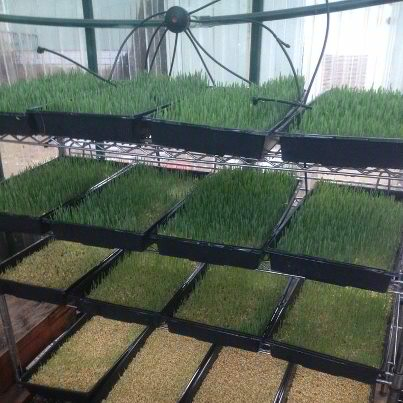
This summer has met us with a number of challenges.  The top most has been the matter of hay, the availability of it as well as the price.  Our usual supplier came up short- in many ways. Other suppliers have orchard grass for a premium price regardless of quality.  This led us on a quest of finding quality feed at a price that didn't compromise the nutrition of my animals.  Equally frustrating is finding a grower that is dependable.  We are not in an environment that supports growing our own not could we grow the quantity needed year after year.  This brings us to the Fodder systems, sprouting barley seeds hydroponically.  There are a number of commercially available systems available that litterally have a "plug and play" start up.  You plug in power and water, put in your seed and in seven days you have a tray of sprouted barley that the animals love, roots, seed, grass and all.  They get fresh feed that is higher in nutrients because they are getting the whole plant including he roots.   Unfortunately these systems have a high price for start up.  It would pay for itself within the first year but I don't have that kind of capital.  We did our research and combined information with our neighboring ranch, dealing with the same difficulties, to find the DIY solution.  

We bought the grow trays from Amazon.  I consider them too flimsy and we are working on a solute to that but for now they are sufficient.   We set up in our current greenhouse both for light and for the existing water system.  Then we started our trials.  


First lesson is that quality, clean barley is ideal.  Stuff that is full of chaff is difficult to rinse and encourages mildew.
We started. With seed from a local nursery but this wasn't good for our bulk needs and the quality, while pure, wasn't clean.  Then I tried the local growers association.  They came up with a clean organic seed but in efforts to try and get the cost a little lower we tried a local mill.  This was the most disappointing because while the tag said 100% barley there was other seed in the bag.  When the mill was questioned they said it was just what was on the conveyor belt and it couldn't be avoided.  This really isn't good enough because the growth from this seed was the worst with mold.  So back to the growers association we go.

Next was light.  It doesn't need much light and it doesn't need a grow light but a light does give more growth in a shorter time.  We found an LED flood light that we put on a light sensor works well.  I saw no appreciable increase in our electric bill and the light comes on at dusk and off at dawn.  Perfect.

Heat.  Barley is a cold weather crop.  This has been the most difficult hurdle to overcome.  When the temps go over 80 fermentation happens.  Not good and hard to control in a greenhouse that is not temperature controlled.  When the weather is in the 70's is when we have the greatest success but as soon as the temps go up growing all but stops and it starts to smell like a brewery.  This means that in our current growing space we can only do this process in early spring and fall.  Summer is too hot and winter will freeze.  What next?

Next will be the ebb and flow system in an insulated, climate controlled area.  Nothing fancy, just the make shift storage area that is tacked on to the back of the studio house.  We didn't build it there but there it is with insulation and water easily installed.  The ebb and flow system is a vacuum that fills the tray to a set level and then sucks the water back out and repeat.  This can work right out of a barrel of water that can be used and reused keeping water usage at a minimum.  The light will have to run full time but again, with LED tech and no need for grow lights this does not figure in any appreciable costs.  It should be mentioned that we are on a well so our first efforts of water were left to drain out on their own.  We are still in the process of getting this set up so there will be more later and pictures to boot.

There are a lot of Internet resources that we used to research what we have so far but the one that really helped push me is the blog from Paca Pride http://pacapride.wordpress.com/2012/04/05/from-seed-to-feed-in-8-days-barley-fodder-sprouting-trials/
I really appreciate his willingness to share his own trials and errors and offer support to us as well.  They too a doing this themselves without the aide of a prebuilt system.  

I realize that this process takes a few extra minutes every day to keep the system going but the math is impressive.  If you figure a pound and a half of seed per tray = about 4-5 pounds of feed and a pound of barley runs about .64 cents depending on where you buy. 

I also realize that this is not the most self-reliant method.  I am still relying on someone else to supply the seed.  I do have control over the quality of the seed I buy and I am still feeding fresh grass over dried and I will be able to feed this all winter.  I can also add extra seed to the trays for different feed needs.  I will be doing one set of trays just for the geese that will be wheat rather than barley, I add flax seed to the barley as well to add extra omega 3.  This also gets feed to my layer flock so I benefit from any extra nutrients I supply them as well.  

Never feed moldy food to your flock but when my fodder does start to ferment I do feed that to the chickens.  Fermentation can actually benefit their digestive system and then I also never feel that a trial was "wasted".  


Monday, September 17, 2012

Fodder and Other Summer Adventures

A whole season has passed me by without a word out there about summer at Haven Ridge.  That is because it is busy and when I sit down to type I'm so tired, the motivation isn't there.

  We had two crias born this summer,  Peninah was born June 11th to our own ReignEllan.
Augustus was born August 3rd to April Snow.

In the midst of these beautiful babies our summer has been filled with the efforts of gardening and the joys of adding geese to our little ranch as well.  Pilgrim geese to be specific.  These guys a very docile and social fowl that have quickly made a place in our hearts.  They greet us when we come out and alert us if there is something out of the ordinary.  
I have not had to mow the grass all summer long! 


Pilgrim geese are the only auto sex goose, females being gray and males white.  Seen here is Millie, Martha, Sophie and D'Artanian.

This summer has met us with a number of challenges.  The top most has been the matter of hay, the availability of it as well as the price.  Our usual supplier came up short- in many ways. Other suppliers have orchard grass for a premium price regardless of quality.  This led us on a quest of finding quality feed at a price that didn't compromise the nutrition of my animals.  Equally frustrating is finding a grower that is dependable.  We are not in an environment that supports growing our own nor could we grow the quantity needed year after year.  This brings us to the Fodder systems, sprouting barley seeds hydroponically.  There are a number of commercially available systems available that literally have a "plug and play" start up.  You plug in power and water, put in your seed and in seven days you have a tray of sprouted barley that the animals love, roots, seed, grass and all.  They get fresh feed that is higher in nutrients because they are getting the whole plant including he roots.   Unfortunately these systems have a high price for start up.  It would pay for itself within the first year but I don't have that kind of capital.  We did our research and combined information with our neighboring ranch, dealing with the same difficulties, to find the DIY solution.  

We bought the grow trays from Amazon.  I consider them too flimsy and we are working on a solution to that but for now they are sufficient.   We set up in our current greenhouse both for light and for the existing water system.  Then we started our trials.  


First lesson is that quality, clean barley is ideal.  Stuff that is full of chaff is difficult to rinse and encourages mildew.
We started with seed from a local nursery but this wasn't good for our bulk needs and the quality, while pure, wasn't clean.  Then I tried the local growers association.  They came up with a clean organic seed but in efforts to try and get the cost a little lower we tried a local mill.  This was the most disappointing because while the tag said 100% barley there was other seed in the bag.  When the mill was questioned they said it was just what was on the conveyor belt and it couldn't be avoided.  This really isn't good enough because the growth from this seed was the worst with mold.  So back to the growers association we go.  It is not worth a few dollars savings if the quality isn't there.

Next was light.  It doesn't need much light and it doesn't need a grow light but a light does give more growth in a shorter time.  We found an LED flood light, that we put on a light sensor, works well.  I saw no appreciable increase in our electric bill and the light comes on at dusk and off at dawn.  Perfect.

Heat.  Barley is a cold weather crop.  This has been the most difficult hurdle to overcome.  When the temps go over 80 fermentation happens.  Not good and hard to control in a greenhouse that is not temperature controlled.  When the weather is in the 70's is when we have the greatest success but as soon as the temps go up growing all but stops and it starts to smell like a brewery.  This means that in our current growing space we can only do this process in early spring and fall.  Summer is too hot and winter will freeze.  What next?

Next will be the ebb and flow system in an insulated, climate controlled area.  Nothing fancy, just the make shift storage area that is tacked on to the back of the studio house.  We didn't build it there but there it is with insulation and water easily installed.  The ebb and flow system is a vacuum that fills the tray to a set level and then sucks the water back out and repeat.  This can work right out of a barrel of water that can be used and reused keeping water usage at a minimum.  The light will have to run full time but again, with LED tech and no need for grow lights this does not figure in any appreciable costs.  It should be mentioned that we are on a well so our first efforts of water were left to drain out on their own.  We are still in the process of getting this set up so there will be more later and pictures to boot.

There are a lot of Internet resources that we used to research what we have so far but the one that really helped push me is the blog from Paca Pride http://pacapride.wordpress.com/2012/04/05/from-seed-to-feed-in-8-days-barley-fodder-sprouting-trials/
I really appreciate his willingness to share his own trials and errors and offer support to us as well.  They too a doing this themselves without the aide of a prebuilt system.  

I realize that this process takes a few extra minutes every day to keep the system going but the math is impressive.  If you figure a pound and a half of seed per tray = about 4-5 pounds of feed and a pound of barley runs about .64 cents depending on where you buy. 

I also realize that this is not the most self-reliant method.  I am still relying on someone else to supply the seed.  I do have control over the quality of the seed I buy and I am still feeding fresh grass over dried and I will be able to feed this all winter.  I can also add extra seed to the trays for different feed needs.  I will be doing one set of trays just for the geese that will be wheat rather than barley, I add flax seed to the barley as well to add extra omega 3.  This also gets feed to my layer flock so I benefit from any extra nutrients I supply them as well.  

Never feed moldy food to your flock but when my fodder does start to ferment I do feed that to the chickens.  Fermentation can actually benefit their digestive system and then I also never feel that a trial was "wasted".  


Sunday, May 20, 2012

it never snowed on the dogwoods

It's summer time at Haven Ridge!  It is full and it is busy.  County fair is close enough that the signs are out and the forms are in. We have eggs in the incubator ready to hatch any day now.  This years meat chickens are having their first day out on real dirt and snapping at bugs.  They are roughly the size of a pigeon right now.  We have roto-tilled the garden and gotten the design ready to plant.    I am currently loading folks up with alpaca manure to aid with their garden needs as well.


And then there are the geese.  We have the new additions to our little ranch, Millie, Martha, and Harriet.  They are a joy and a challenge.  I never knew geese were so pushy!  They challenge every possible gap in the fence because, well, the grass is always greener on the other side!  Of course.  Then once they are out they just follow their nose to where ever it may lead them.  This makes them hard to locate at bed time and worries this ranch mamma to death because they are just babies and don't know about the bad guys in these woods.

Speaking of bad guys we have already had our first bear visit.  It went after the chicken feed and fortunately got discouraged by the lid and left.  Our neighbor across the canyon has had one walk right by her while she was milking her goats!  Broad daylight too.  So we are on our guard and trying to keep things locked down tight.  This is life in the forest.

The alpacas were sheared the end of April.  Perfect timing as the weather just really got warm after that.  I am looking forward to spinning our new Suri, Danny.  I am going to try to be good and hold off until, my other responsibilities a down.  I have promised a lady last fall I would spin her cat fur (chaingora) and I must get it done.  It makes my nose itch so it has been easy to procrastinate.
The ducks and chickens have figured out its warm now and we are over flowing with eggs.  It's very gratifying after all these years of building up our flock to finally have enough for us and enough to share.  And that brings us the Farmers market that should be starting the second Saturday of June.  I will be there with yarn, mom's market bags, some knit items, and hopefully - eggs!  If you have never tried duck eggs this is a great opportunity.  $3.50 / doz. 

Haven Ridge has met some wonderful new friends here "up-country" at Quartz Ridge Ranch.  We have similar goals and out looks with completely different animals.  She raises goats and chickens and runner ducks and new guinea hogs!  Heritage breeds.  She knows her stuff and if you're looking for fresh goats milk I would confidently point you in her direction. She even let me try milking!  

Knit Knite has turned into great fun.  It's not every Friday but we do have good food, wine, and YARN.  The best part is the friendship.  Living rural has its draw backs and it's nice when the mammas can get together for some adult time.  I'm thinking of making it more of an early afternoon activity for the summer months.  Any feed back on that would be welcome.

If you're looking for me, look outside or on the go.  This place doesn't run itself!  

Wednesday, March 28, 2012

It's Been Pretty Wet

The weather finally started acting like it's winter just in time for spring. The daffodils are blooming and it just wouldn't be normal if it didn't snow on the spring bulbs.

The animals are soggy and give me disparaging looks when I open the barn and shoo them out in the morning. The mud gets to me a bit too. It's hard to believe that in just a short month or so we will be shearing. This will be my first year with Danarious, my rose grey suri and I can't wait to get it cleaned and ready to spin.

With the coming of spring also means that I am gearing up to start vending at events and, my favorite, Farmers Market. This year I'm hoping to talk my new friend up the street to sell goat milk soap with me at the booth. Maybe knit up some alpaca loofah soap bags to go with them. Teresa raises heritage breed goats at Quartz Ridge Ranch both for milk and meat and I am pleased to have met her!

My first event this year will be in Cool, CA at Northside school for their Civil War reenactment event April 14 and 15. I will be duly occupied also as a 4-H representative. If you have any questions about getting involved with 4-H I hope I can answer them for you. As always I will have yarn, shawls, gloves, and maybe a hat or two. I will also have drop spindles and fiber for those of you who like to start from the beginning.

No dates for shearing yet but my shearer has had a pretty tough year, so I'm sure I'll hear from him soon.

Life here gets busier all the time. We are getting ready for planting season, I have a couple of students coming to learn about the animals and the process of bringing fiber from raw to yarn, and getting ready for El Dorado County Fair.

Soon we'll also break out the incubator and work on getting some baby ducks.

I love spring and all the action just waiting around the corner!

Friday, January 6, 2012

So You Want To Bring Home Alpacas?


What do you need?

The first thing will be secure fencing. Alpacas won't challenge a fence like a horse might so you're not going to need to electrify it but alpacas are vulnerable to predators such as your neighbors dog or cougars. "No Climb" is the most common fence used, weld wire will work but isn't as long standing. I do have a radio wire around my fencing but that is to keep my livestock guard dogs from wandering. Also you will want to keep brush and tall grass down and away from both sides of the fence. Alpacas are curious creatures and are prone to snake bites. Once your fencing is up, scrutinize it carefully for sharp or poky places. Alpacas like to rub up on things and anyplace that sticks out could wound your animal.


Water Bucket. After acquiring many buckets to put extra water out during the summer months, I finally broke down and bought the self refilling ones. This was one of the best things I ever did. No more worrying about water when I have to be gone all day.


Cleaning Brush. Water buckets get dirty and need to be scrubbed out regularly. I found that a wheel brush from the car cleaning department of your local All-In-One store does a great job of scrubbing the rounded bottom and sides of the buckets.


Feed. A bucket, container, or other device for feed. Putting their grass in this container doesn't mean that they won't pull it out, roll in it, and eat off the ground anyway but when the weather is bad, it's good to have something to put it in.


Pellet bowl. Something with a flat bottom. Alpacas love their pellets and get very excited about feed time, sometimes they will wolf down too much and choke. A flat bottomed bowl keeps the pellets spread out so they can't down too much at one time. If you are still experiencing "choke" try putting some rocks in the bowl that will cause them to eat around the rocks and not eat too hurriedly.

Shelter. Someplace they can go to get out of the elements. Whether it's hot, cold, windy, or wet every creature needs a place to be comfortable. This can be a separate place from where they sleep at night or the same. This is also a good place to feed them so that their food doesn't go to waste in bad weather. If the shelter is the same as where they bed at night it should be a place that you can secure against predators.


Clean up. I use a trash catcher from Home Depot and a small plastic rake. I rake into the catcher and then dump into a wheel barrow. If you only have a few animals the wheel barrow is probably not necessary. Decide ahead of time where you are going to dispose of your manure. Alpaca is excellent for gardens.


Toe nail trimmers. Nearly the only maintenance your animals need aside from annual shearing and vaccinations, this $20 item is a must.

Good fitting harness and lead for each animal.

Extras:
We use these recycled, plastic street cleaners, stood on end over pressure treated posts for scratching posts.


If you live in an area that freezes, these frost free water bibs are a must. They turn off underground and the above ground pipe drains out. Make sure it is lead free.


A chute. There are a number of ways to manage your herd and if you have someone else to help you this may be unnecessary, but for a difficult animal or working on your own this contraption is wonderful. It secures the animal while you manage it's needs. This can be as simple as toe nails or as complicated as treating a wound.


Speaking of wounds, they happen. Alpacas rub their faces on everything, can't always see where they are stepping, get curious about dangerous things and just occasionally find themselves in trouble you cannot imagine.

A few things are important to have on hand
:
Triple antibiotic ointment
Sterile saline (contact solution is fine, it's for rinsing out wounds or washing out eyes)
Vet wrap (lots of it)
Non-adhering gauze pads
And finally and MOST IMPORTANTLY the number to your vet and vet hospital preprogrammed into your phone. Email is good too. These are the days where we can take pictures of our pets wounds, email them to our vets and get more immediate advice on the action to take.

This is a good basic list to get you started. You'll hone in on your own specific needs as experience teaches you.

If you are raising your alpaca with plans to utilize it's fleece, take a good look around at your pasture. Alpacas love to roll and take dust bathes. If your designated area is full of weeds and plants that have sticky seed head you can count on all that getting stuck in your fleece and needing to be cleaned out. Not a fun project. The cleaner your pasture, the nicer the fleece will be.

Do you have a low to the ground sprinkler head? In the summer time they love to play in the water. A low sprinkler placed just outside the fence is a great way to help them cool off and a lot of fun to watch. Make sure it stays low so that it only sprays their under belly and legs. Water gets trapped in their coats and the hot sun will steam them to death.

As with anything before you bring home alpacas make sure you research carefully, visit other ranches, ask lots of questions and make sure there is a local vet competent with camelids. Make sure that the ranch you purchase from is going to support you post purchase. If you are purchasing young males that will need to be castrated in the future, keep in mind the cost for that, and mark on your calendar when you need to think of such things.

"Luck favors the prepared Darling.". -Edna from The Increadibles

Friday, October 21, 2011

It's not easy being green, or is it?

Sometimes it's about paying attention to our actions, sometimes it's just about saving money. It's even better when it's both.


I live in a big house. Not exactly a suburban McMansion because it's much better planned out than that but it's still a lot of square footage. So we do lots of little things to keep costs down. Thermal drapes, efficient light bulbs, and keeping unused rooms doors closed are just a few things that keep our electric, heating and cooling under control. There is radiant heat and a whole house fan the former not quite as efficient as it was when we first started building as propane costs rose. Still for a 4 thousand square foot house, our electric bill is rarely over $150 and thats with seven people living here and a water pump that also uses electricity.

It irks me that I pay sewer and water taxes when there is no such thing in my area. I have a well and septic. You can then imagine that we are very conscientious about what goes down the drain. This is partly what led me to using natural dyes on my yarn. I don't want harsh things in my water table. This has also led me to making my own laundry soap and household cleaner. It's amazing what vinegar and borax can accomplish and with a little essential oil it smells lot nicer too.

So I want to pass on the laundry soap recipe website and tell you that not only is it a nice clean but it costs a lot less too. Living 30 minutes from a market also means that if you're out there is no quick trip to the store. Making your own means that when you're out you just whip up some more. I will add that I use a liquid Castile soap. My kids have very sensitive skin and Castile is nicer than soap. I remember when C was just a baby and getting a bath in the kitchen sink, a bar of Dove slipped off the edge and into his bath water. His whole body broke out in red itchy blotches. I am not a fan of the Lever company.

http://www.thefamilyhomestead.com/laundrysoap.htm

From the same site here is a multiple purpose spray cleaner. The author lists another recipe but I am uncomfortable using ammonia both for it's potential volatile nature and the smell is awful.

All-Purpose Cleaner 

2T vinegar

1 t Borax

Hot water

a few drops of a mild dish detergent

10 drops of essential oil, optional 

In a 16 spray bottle put vinegar, borax and  hot water.  Swish around until borax has dissolved.  Add the drops of dish detergent and fill the rest of the bottle with water.  Add the essential oil (I like using orange or lavender). 

I use baking soda for scrubbing.

I wanted to pass this on. I want to add my voice to all the others out there that are saying no to harsh chemicals, no to spending big money on brand names, and no to adding more crap into our water table. I just need to get the dirt off my farm clothes and I don't need fancy labels, I don't need it to be colored or smell like the great outdoors. It just needs to clean the red dirt out of my clothes.

And one last thing: anything bleach can do peroxide can do. One will kill you if you ingest it and one will not. One is toxic and in some countries is a controlled substance the other turns to water in the sun.

Wednesday, October 19, 2011

Here Comes The Fall

The leaves are changing, and we've had our first good storm opening the door for all the rest and leaving us with nice wet ground for future burn days. That was the first thing I did after the storm was get rid of the back burn pile. The front one will take a little more effort. It has grown large enough over the summer that I will need to use the skid-loader to pull it apart into smaller bits.

The colder weather has turned everyone's thoughts to keeping warm and the requests for alpaca socks and gloves have started. I must disappoint because I have neither. I have hats, and shawls but no gloves and no socks. I can tell you where to get them!

On the same line with keeping warm is the need for fire wood. The storm spurred everyone into action on the hill and I hear chainsaws around every bend. We are no exception. A good friend loaned us a log splitter and after one intense weekend all the logs that my dad had spent time bucking up were turned into about 6 cords of wood, both oak and pine with extra for next year as well. When they logged, down the hill from us, the logging company brought us all kinds of lovely oak. That was last year and so this year we are truly blessed and it will continue to bless us into next year as well.
Stormy weather? Bring it on!

Last weekend was also the last farmers market in Garden Valley till next year. I will miss all the people that comprise the market and the regular community that congregates there. This last week I brought two alpacas to visit as well. I was surprised at how many of the regular people that I had talked to numerous times seemed to see me in a new light with the critters there. Suddenly my spinning took on whole new meaning. I came away with three new orders. A nice way to end the summer. It is actually what brought me back to the computer to update the blog, my fingers needed to do something different after knitting all day. The boys I brought were very well behaved and both kids and adults were enamored with them.

Some weeks ago a new alpaca came to live with us. "Danarious" or just Danny. He is a young rose gray Suri and I am in love. He is very well handled and easily approachable. His coloring is something special and next springs shearing just cannot come soon enough as far as my spinning wheel is concerned. He fits in nicely with the rest of the herd.

The rest of the goings on here are very standard for this time of year. It's time to wind down the garden, clean up the summer things in preparation for snow, time to think about snow tires and stock up on gas for the generator. This year I'm going to try a cover crop over the garden. I have some winter cereal rye that is supposed to do well in cold climates and help create an insulation layer when it snows to promote good bacteria growth for good soil in the spring. I've never done this before so it will be an interesting experiment. I'm not sure when to start it or if I'm already too late. There are still things to be harvested from the garden and even then I want the chickens to come through and clean up before I put down new seed. For now it has warmed up a bit and I will continue to pull zucchini and tomatoes out until they give up as well. It is probably only a matter of weeks before the first frost. Stay tuned and I'll tell you how it's working. If all goes well, I will have rye for my chickens to snack on. Healthy for them, healthy eggs for me.