Sunday, September 8, 2019

The Blue Line Forest

     The landscape at Haven Ridge is about to change dramatically.  As some of you may know we have been evacuated twice for fire.  Once for the Trailhead Fire and once for the King.  This is extremely stressful and yet both times we had time to get all 20+ alpacas, 3 cows, 4 big dogs, 3 pigs+ their babies, 6 rabbits, and too many to count chickens and ducks (with a lot of help from friends).  It’s a lot of lives to be responsible for and they count on us for their well-being and safety.
   
     We have lived here nearly 20 years and work hard to keep our grounds clean and with good clearance but it’s still a 12.5 acres of forest and after 20 years there’s been a lot of growth.  It’s more than we can keep up with and still be fire safe.  With that in mind I got some referrals and called a logging company.  It seems like it would be a simple task, sell the trees, they’re my trees, but it’s not. It’s California and there’s permits and if you can get other properties nearby to go in with you so the logging company only needs to bring out its equipment once, you’ll all profit better.  The paperwork involved in all this means that we might get started next spring.  Not a quick process at all.


      That said, we got the ball rolling, have neighbors also interested in fire prevention, and a forester came out and evaluated our property.  Then came out again and we went over the entire property with spray cans and marked all the trees that they will take.  To be under the fire prevention permit they are only taking the ones that are larger than 12 inches in diameter and smaller than 30 so do not fear that this is a clear cut.  This is going to make room for the healthy trees to thrive.  If you are familiar with the bark beetle issues that have plagued our forest the last few years you will understand what a huge benefit this will be.  This will give us space so that when (not if) fire comes our way we have a better chance of saving our house and preserving our hill.  It helps that the U.S. Forest adjacent to us will also be doing their own fire clearance and our neighbors at the corner will also be part of our project.
     So now I look around at the blue lines and try to imagine what my skyline will look like next year, what space we will have and while I’m nervous I’m also excited!!  There is a lot of unused space out here that has always been a nice forest backdrop to our lives but I’m now seeing that it will be available to utilize to rotate the animals on and let the ground they’ve been on for 12 years now, rest.
No more cleaning pine needles off the little house, and more sunshine for the orchard.  I’ll even be able to move the chickens out of the orchard.

     It’s going to be a big change.  It’s going to be a lot of work on our part to move all the odd piles of scrap to give the loggers the space they need and even relocating some of the animals.  In the end I hope we will have made the difference needed.

    So.  We are selling these trees.  A great deal of the funds go to pay the forester for all his time and headache with the paperwork and you pay the timber company and all that that entails and hopefully when all is said and done there’s some for you.  There’s no guarantee on that it depends on the bottom line at the end and how much volume they harvested from your space.  At the very least, you are getting your property timbered and cleaned up for fire safety and you don’t pay anything.  It’s a win! But hopefully there’s enough for going out to dinner later.  We are hopeful for a little more than that and whatever it is will be put toward getting Haven Ridge solar powered!  I will make a separate entry on that as we get closer.  


Tuesday, January 23, 2018

More About the Milk Cow (Zoey's second baby)

     Hannah has gone home.  She was a great milk cow but her temperament was never going to win her a lot of love.
    Zoey gave birth to a healthy little guy December 8, 2017.  It took almost nothing at all to remind her about going into the chute for milking.  She knows there's treats waiting for her.  All the work we did with her early on just keeps paying us back.  There's no kicking, no tail flicking, and no passive aggressive defecating.

    Still not without it's own individual challenges.  She still, as any good mamma would, does not let down unless the calf is there to stimulate her.  That does mean time training the calf to not be shy about coming over to suckle.  After about a week of persuasion and a little bit of chasing, he's got it now.
    The hurdle before that is the extra time in my day.  This is a winter calf, not ideal for our lifestyle.  It means the nights are long, too long to separate mamma and baby for morning milking.  I did try.  By one a.m. the bellowing started.  I tried to ignore it.  I tried to sleep.  I knew some noise was going to be inevitable and tried to rationalize it and tell myself that there is always a lot of noise the first time.  The calf is just in a small stall, Zoey can still see and touch but another hour down and I started counting the hours since darkness fell and we had separated and how many more hours till daylight.  Then I felt guilty.  Guilty and irritated because now I am responsible for this noisy, miserable, mamma.  But I wasn't about to give up on my milk acquisition.  I am too stubborn for that.  So I went out in the dark, glad for the very mild winter we have had so far.  Other than some confusion from the flashlight, Zoey went right to the chute, baby went right to mamma and I got my milk and went back to bed. 

    For now, because my sleep is precious to me, I separate in the morning.  The baby thinks that it's half alpaca anyway so he goes over and romps with the other yearlings.  For now I feel safe with this.  He is, in reality, half  low line Angus and he is naturally polled.  This means no horns to push the alpacas around with.  Mostly he is content to hang out with them and feel part of the herd until it's lunch time.  I come out at lunch time to milk but as you can see, this does break up my day a bit.  It means that there are some days where other obligations take priority and we just leave the little guy with mom. That's the beauty of the system.  I am looking forward to the spring when the days get longer and the night is short enough that we can change the arrangement without too much stress on all involved.
     A few new experiences to note.  Vertical cuts in Zoey's teats.  These are apparently caused from the calf's teeth as he strips the teat.  This didn't happen with the last calf and he is still too young to even consider weaning.  The suggestion is to use a Dremel and take the sharp edges off.  This will be similar to what we do to cut back the long front teeth of alpacas when they grow past the natural line of the gum palate.  My intention will be to just take a light sander to the edges so not nearly as severe.
    In the meantime we rub her teats with coconut oil to help her heal.  It doesn't help that it's winter and dry.
     We are a little more than a month into this and this is her second calf.  I am getting nearly half a gallon a day.  The cream is not as plentiful as Hannah's but it is thick and lovely.  For this being just her second freshening we are pleased and feel that all things have gone as expected within reason of what living beings can offer. The teats are longer this year and easier to milk, she knows what's going on so the learning curve is easy, and my hands are more accustomed to the job as well.
     It's important to remember in this world of industrialization that farm animals are not machines.  They can be bred to produce for the masses but that is not the goal with our homestead breeds.  We need to work with them as their individual needs and personalities dictate even when it means changing how we do things.  Owning our family milk cow continues to bring me great satisfaction even with the mental gymnastics of maneuvering around what is best for calf and Zoey for the end result.  What have I learned from this?  Next time make sure to breed for a spring baby when there are short nights.  
    

Sunday, October 8, 2017

Keeping a family cow. For real.

     About 6 years ago I met a miniature cow.   That was when the seed was planted.  I started talking about wanting a cow.  Sometimes, I would talk about it just to annoy my husband but other times I was really pondering if it was something we should consider.  I started asking more questions and doing more reading.  First thing was to sort through the myths of keeping a cow as well as making sure the information gathered was based on actually keeping a homestead type cow vs. industrial dairy cow.

     Books by John Seymour were extremely helpful and the most practical of all the books.  Yes, the other Family Cow books were very helpful but not as practical for someone that just wants to keep a cow or two not run a cattle business.


     So fast forward a few years and I make contact with our local lady who specializes in homestead specific cows.  Not Big-Wall-Of-Meat cows.  Not miniature cows either because they aren't that practical.  No.  These are heritage cows or crosses.  She listened to me and understood what I was looking for and what my personal fears and concerns were.  Did I say fear?  Yes.  Fear.  Big animal that could run me down or gore me.  So she was breeding me a specific cow.  A Dexter and Jersey cross called a Belfair.  The size and efficiency of a Dexter, the milk and cream of the Jersey.  Efficiency is important.  Nobody needs a cow that will eat more than she gives.  Heritage breeds excel at this.
     Now I have to convince my husband that this is a good idea.  I'm not going to bore you here with the ins and outs of all the reading I did, or the history of my family and food allergies and looking for ways to healthfully feed my family or the ways to be self-sustaining.  I will tell you that part of my research did include considering dairy goats and what I found was that while in a pinch I can see them as being good options, for the long term and not pinched, we do not really prefer goat milk or meat.  It does not pay to invest in something that you will never really love.  What I did was make a loaf of fresh bread, smeared it with fresh (I had just made it) butter and handed it to him.  He did not put up much of a fight.  No fight at all actually, one bite and he agreed, we need a cow.

     I did, just as I did with the alpacas, go spend time with my friend and her cows.  I learned how to milk.  I asked a lot of questions.  Two years ago we brought Zoey home.  She calved the following May and the real test began, milking daily.  Well, not exactly because she has a calf and that was part of the selling point of keeping a family cow.  If I am unavailable to milk I can just leave the calf with her and there is no issue other than not having milk in the house.

     Now this brings me to the part of the story where I recall people being concerned, many years ago, that I was buying 12 acres and "What was I going to do with all that land?"  and I replied, "Anything I want."  Later I was asked, "What was I going to do with alpacas?" and now the question, "What are you going to do with all that milk?" and, "Nobody needs that much milk."  To the people who questioned me, I am just glad that I do not have your lack of imagination.

     First of all, because I am sharing the milk with the calf, it's not more than I can deal with and second even now while I am cow sitting for a cow that does not have a calf on her we are by no means unhappy with our glut of milk.  This brings me to the meat of this post, what DO I do with the milk?  Is keeping a family cow worth it?

      The answer is simply YES.  In fact right now I am feeding three cows.  One, Hannah, is just here temporarily, Zoey, and her calf, who is 17 months old now.  Roughly 8-10 flakes of alfalfa a day.  Zoey is due with calf #2 next month and Hannah, is a Jersey in milk.  Alfalfa is currently $12/bale as long as you buy direct and not from a feed store.  I get about a gallon a day.  Grass fed, non-pasteurized milk, last I checked is $12.75.  From two day's milk I can collect about a quart of cream.  Sometimes this is turned into ice-cream or caramel but most of the time I turn it into butter.  It yields about 1/2 a pound.  A pound of raw, lightly salted butter is $11.00*.  From the buttermilk collected after churning the butter I add three tsps. yeast, 2 tsps sea salt and enough flour to make an elastic dough.  Buttermilk bread with no sugar or additives.  A large loaf of buttermilk bread is??? $4-5.  Yogurt is also a favorite around here.  We prefer the whey drained from ours and a half gallon of milk yields about three pints of yogurt.  Today we made our first soft crumble cheese.  I am excited to sprinkle it over tonight's salad.
Yogurt, out of the thermos and into the strainer.

      When Zoey was in milk I did not get quite the same yield as I get from Hannah.  That may be different this next time around since last time was her first baby and they are different breeds.  Hannah definitely has a higher feed need.  But you can see that the cost of feeding these cows is much less expensive than buying (assuming you can in some states) quality dairy and bread products.  Also, keep in mind that Zoey's calf from last year will be next springs harvest, so some of that feed cost is going into next springs meat.  All this plus you know where it's coming from, and what it was fed, and you are directly responsible for it's quality of life.  If you are a label reader and you could write your own label for your food and know that it is the truth, this is the ultimate.

     All of this does assume that you have the time to make all this but it doesn't all happen every day and some of it doesn't require much direct supervision.  The butter, I pour in a food processor, turn it on and walk away. While it's spinning I start the yogurt on the stove. The Yogurt, once you bring it up to 180 degrees and hold it there for 15 minutes, you cool it back down to 108, add your culture, put it in a thermos and forget about it for a day.  We drain it after that, which is our preference, but you don't have to.   When the butter separates you will hear a distinct watery noise from your food processor.  Strain the buttermilk from the solids and put the liquid in your mixer.  Rinse your butter under cold water and let it continue to drain.  Add your yeast and salt to the buttermilk in your mixer and mix in flour with the dough hook until it is elastic and not sticking to the side.  Knead by hand into a ball and place in a bowl to raise.  This will take an hour or so and now is when you clean up, add salt to your butter and "squadge" it, as John Seymour would say. When most of the liquid is squished out, put the butter in a mold or container.  I freeze our extra so that there is butter when milk is not as available.
      When the dough is double you can punch it down and place it in your bread pan for a second rise.  When it's double again bake at 375 for 20 minutes.  This is great bread for sandwiches, or just toast. 
Cream in the food processor
butter solids separate


Strain out the buttermilk
press into molds and chill

buttermilk dough


     There you have it.  Milk, butter, yogurt, and bread.  That's not even touching cheese if you are so inclined.   That's what you can get with your own cow.
buttermilk bread
Now for the REAL.  
     She will not always be in milk and you will still have to feed her.  Just keep in mind the lovely beef from the calf one day.  If, at all possible, you might work out an arrangement with another local dairy cow owner to be in milk while your gal is dry.  That would keep the two of you in milk most the year long.
     You will be milking mostly once a day to keep production up.  It will rain, or wind, or snow on you but this is true of all livestock.  I don't recommend just jumping in with cows if you are not already acclimated to farm life.
     Cows are masters of the passive aggressive.  They can be stubborn and willful like a two year old.  Temperament of your dairy cow is important because they don't always want to be milked and it takes time and training to get her to a routine of behaving herself.  She will still pick up her foot and knock over your hard worked for milk pail and yes, you do cry over spilled milk.  IF she does it too often the term Kicked The Bucket will take on a whole new meaning for you.  When you are not ready for it she will lift her tail and defecate.  That's a special kind of passive-aggressive because you can't really yell at her for it.  Sometimes milking just stimulates that.  But I would be lying if I didn't tell you that sometimes I'm sure she does it on purpose.  There is also the flicking of the tail.  It seems so casual, natural even, but the third or fourth time she has slapped you with it you will realize there's more to it than that.  You can tie up her tail and she will learn.  Just like that willful two year old, she can be disciplined.

     There is much to consider, as with any livestock, before you commit to it.  I am here to say that six years later after really thinking about it I am a very happy cow owner.  Zoey is a great cow.  I was fortunate to get her while she was young and be part of her training so now even though she out weighs me and has horns we have an understanding.  Much like training our LGD's when they are small so that when they are bigger we have good manners, cows are very much the same. 

      Not much is needed in the way of equipment for milking.  You can strain using one of the reusable coffee filters but when you do decide to invest in more permanent equipment I recommend www.shenandoahhomesteadsupply.com

Are you interested in trying?  Cricket Bishop will work with you and even offers "leases" so that you can try this lifestyle without the full "I bought the cow" commitment.  


*prices based on OrganicPastures.com

Monday, June 12, 2017

Hail in June

June 12th and yesterday it hailed. 

Today continues to be cold and dreary and my poor shorn alpacas are out shivering.  I tried putting coats and sweaters on them but they would have none of it. 

I have just a few mamma's due anytime soon.  I hope they wait till later this week when the temps are supposed to climb and be in the 90's.  Never boring in the Sierras.

This week starts El Dorado county fair and all that that entails.  Just to complicate things the trucks transmission went out.  We are borrowing cars and trucks to get around.  Thank goodness for the generosity of friends.  If you're in Placerville this coming Friday, we will be in the horse arena at noon with alpacas and llamas.

Farmers market started this month and with it all the wonderful community that comes out and joins together at the park Saturday mornings.  Wonderful friends and music come together and purchase locally produced crafts and garden fresh veggies.  We are so blessed to have such a group that keeps this market going.  Katie of Stardome Alpacas of Cool and I set up and have our handspun alpaca yarn and and hand knit gifts available as well as some commercially produced alpaca items.  The most popular being alpaca SOCKS!  Warm and soft.  We are still working toward our goal of getting our own sock machine and providing our area with socks made from our own alpacas.  Keep watching here as things start coming together!!

Thursday, May 18, 2017

A Day in the Life:

It's that time of year again, time for me to update this blog and talk about all that is new on the farm.  
Of course it's spring so some of what is new is baby ducks, chicks, and goslings.


We are agisting a friends llama here and she is due the beginning of June.  
We had two arrivals over the winter, unplanned breeding, but they are doing well.  Noel was born the end of December, a deep brown little girl.

 Janos, as his name suggests, was born in January.  He has had a rough start dealing with both a herniated umbilical as well as some defecation issues and weepy eyes.  He hung in there and we got him a special belt to help with the tummy and started him on antibiotics.  5 months later and he is keeping up with the best of them.  

It has been a cold and extremely wet winter.  Only now, more than half way through May, is it starting to dry out.  Our Fire Wise council is still cautioning us that the fire threat is high this year because while the ground is damp it also increases the grasses.  Last year over the 4th of July we were evacuated for the nearby fire.  This is the second time within 3 years of having a fire threaten our area.  A better way of viewing it though is that after living here for 17 years, we have only been evacuated twice.  That's not bad considering the way California doesn't manage it's forests.  It also means that with the fire and back fires and logging they have done to clear the burnt areas I am optimistic it will be another 17 years before I go through that again.  I can hope.

Last year, after doing my diligent research, my husband and I made the jump and invested in a dairy cow.  A Dexter/Jersey cross to be exact and her name is Zoey.  She is small as cows go and not without challenges. 
     I can say that the early efforts of working with her as a young cow have paid off immensely.  May 5th 2016 we were surprised by an extra set of eyes being unaware that she had been bred before she left her birth home.  We knew it was a possibility but we didn't know.  A little boy.  We don't name him, he will be going to freezer camp this fall.  It did speed up our original plans but in a good way!  It has been a learning curve to to figure out how to get milk from her when she wanted to hold it back for the calf.  And cream!  We had to learn that she could even withhold the cream.  Who knew!  Well, our mentor did and she gave us some helpful hints on how to get around it and get our share of the goodies.  All part of the plan was to leave the calf on her so that we were not required to milk daily should the need arise.  When we were ready to ween him we tried a couple different nose rings that black him from nursing but swing forward when his head is down so he can eat and drink without issue.  This cuts down on his stress (and less mooing for us) because he is still with his mom but has to eat like a grown up.  We get about 1/2 a gallon a day, give or take.  What do we do with it?  We drink it for sure but we also make yogurt and butter.  I also take the leftover butter milk and make a nice buttermilk sandwich bread.  

I am often asked how much money we save by raising and butchering our own meat and now with the addition of milk, butter and bread. (cheese will happen soon) The answer is: We don't.  Don't ever go into this thinking your budget will somehow be relieved by not needing to purchase these items.  What is relieved?  Your stress.  Daily I read articles about what they have added to industrially raised food, sprayed the crops with, injected the meat with....It's never ending and only serves the bottom line of the industry.  I know what my animals eat and I don't use chemicals.  My dairy is not pasteurized or homogenized.  My bread has 5 ingredients: sourdough starter, yeast, flour, buttermilk, and salt (sometimes, I indulge in some honey).  No HFCS.  That feels pretty good and I enjoy the routine of making it all.  

What about the alpacas?? Well they're fine.  We are looking forward to some new little additions this summer.  The 4-H boys are sheared and ready for county fair in June and state fair in July.  I am about half way through shearing all of them but it's been a late start, did I mention it's been a very wet winter?  Just two days ago it felt like a late fall day, rain and cold.  But I do have some very big plans this year concerning our alpaca business.


     Together with a neighboring ranch in Cool we will be making our own alpaca sock brand made with our fiber not a co-op.  Stay tuned as there will be a Kickstarter project to try and get this off the ground faster but by hook or by crook we are going to make it happen.  They will be machine washable as they will be blended with another natural fiber.  

You see, the socks I sell now are made in PA and sold out of La Jolla, CA.  They are great socks, I really like them but they are 45% micro fiber.  Several articles have come out now discussing the microscopic fibers washing from our laundry into the ocean and they are from all the polyesters, nylons, and polar fleece that so much of our clothing is produced with. It's starting to really accumulate and I don't want to be a part of that.  https://www.organicconsumers.org/news/will-clothes-companies-do-right-thing-reduce-microfiber-pollution  Yes, there will still have to be some nylon/spandex in our product to give it some stretch and the one size fits most aspect that people come to expect from socks but we will be pairing our alpaca with a natural fiber that will still give it strength, softness and wash-ability.  I don't know about you but I'm not a fan of clothes I have to remember to not throw in the washing machine.

So please stand by for our Kickstarter project and support our goal if you are so inclined! 


Monday, April 11, 2016

Hope But No Promises


Farm life is a lifestyle full of hope and no promises.  No promises anywhere, anytime.  There is no promise that tomorrow will be like today because livestock and the weather, by their very nature, are going to change things up for you.  

Today you have 10 chickens but later today a coyote might come through and now you have six.  You look again 25 days later and you have 7 and number seven has 7 little chicks in tow.  The sow you were sure you had bred turns out she was just fat, but 20 days later you find you were just off on your breeding date and now she has little piglets suckling on her.  There was hope, but no promise.  

You can’t make any promises either.  You can have plans but you had better get used to being fluid on those plans.  Yes, you planned to meet your friend for lunch but as you were pulling out of your drive you look over and see your precious Petunia Pig on the wrong side of the fence tearing through your neighbor’s garden.  By the time you have lured her back to her pen, fixed the fence, and cleaned up you’re well beyond late and looking at an early dinner if your friend still has time.  

You did promise you wouldn’t bring home any more farm animals but, “It was a good price” “It was abandoned” “We don’t have one like this! Think of the breeding possibilities!”   Don’t make promises you can’t keep.

Hope.  Hope springs eternal and hope is sometimes all we have to cling to in this precarious lifestyle.  There is hope that the pigs will all stay penned.  The hope that when we finish this grow out we will have a freezer full of food that we trust where it came from.  The hope that with the work of raising, growing, and caring for one thing we will be able to trade for the items we still need.  The hope that our friends, that live differently, will understand when we are an hour late because farm life happens.  The hope that even when one of our herd/flock dies and our heart is broken that there will more life to follow.  The hope that that tiny seed we pushed into the dirt will spring up as food later this summer if we water it.  It seems unlikely but 30 days later, there are the leaves, pushing up and encouraging our hope.  When the hail comes down and batters those leaves, we persist and plant some more because we hope.


I write this the day after finding a cria that died over night.  Yes, he showed signs that something wasn’t quite right but I couldn’t find anything definitively wrong (not without $$$ of tests) so this was unexpected.  I am sad.  His birth was the hope of bringing in new blood, new color, and new temperament to my herd.  In his death, following the necropsy, I have found a weak point in the genetics of my herd and learned that I need to move a different direction.  The loss hurts but we cannot mourn for long because just around the corner is the hope that last summers’ breeding will bring new life this coming summer.   


Farming is not a lifestyle for those who need promises.  There are no promises that even when things seem ok that tomorrow a different truth might emerge.  The learning curve on this point can be quite steep.   You can hope and as you learn to go with the flow of things your hope will become grounded and your optimism will grow.  You will find that hope is worth waking up to. 

 I promise.

Monday, February 1, 2016

Time To Get Ready

It's February.

     Time to start seeds.  Time to get fiber processed before the spring shearing rush. Time to think about getting new chicks.  Time to get equipment ready for shearing.
   
I've sent about 50 lbs. out to Heart and Soul in Penn Valley to be cleaned and turned into roving.  That will make getting it spun up into yarn happen a lot faster than if I clean it myself as well as make it more enjoyable for me.  This also means nice clean fiber available for other spinners will be available for sale.   This year I have a bit of motivation for getting more product available.  You see, come September the World Gold Panning Championship will be held in El Dorado County.  I am planning on having the ranch open for any visitors exploring this area of the divide as well as products to show off what our beautiful alpacas provide for us.

     Next on my list of to-do's will be to get some dying done.  As usual it will all be natural dyes. I am spinning whites as fast as I can so that I can offer a variety of color this summer at the farmers market. 

     February has started out with snow on the ground and high 20's temperatures.  We had great rainfall totals for January and I am hoping it continues for the next three months.  It makes work sloppy and muddy but it sure beats drought and higher than usual fire danger.

     While the ground is soft I will be pulling some ground cover plants to be replanted later after I re-landscape an area that has been left fallow for some years and hope to revive the garden area in front of the studio/guest house.  It will involve fixing the drip irrigation which has also been left to sit for last few years as we have coped with low well levels and too many holes in the main line.  My goal will be to not only get the water set up and on a timer but get flowers back in and screened from the veracious chickens.  I could pen up the chickens but that means they can't do their job of keeping the bug population in balance.  So I would rather protect the plants.  It's odd but it works.

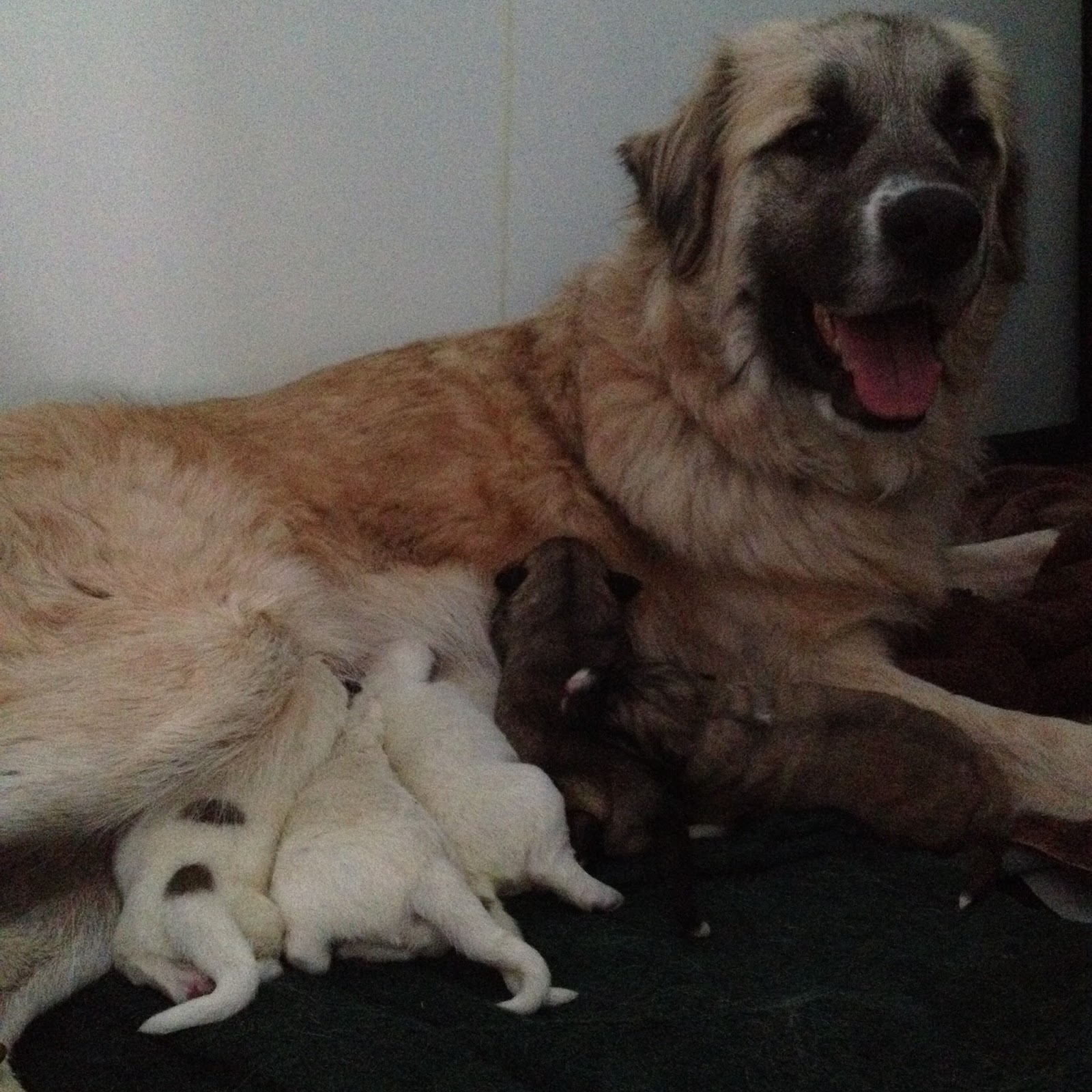
     This month also brings us the bitter sweet moments where we will have to say good bye to the puppies that have given us so much joy these last few months.  Some will go to their new homes this week and others will stay on a little longer to get more learning time in with the older LGD's as well as time to get big enough to handle themselves at their new job sites.  My feed bill will be relieved but my heart will miss their fluffy little faces.  I will breed again.  My oldest and my first LGD's are eight years old now.  It's sad but these are not long lived breeds.  Sasha is showing her age lately and it will be time to bring in younger workers.  I never imagined when I started an alpaca ranch how much these dogs would come to mean to me.  I love having their eyes, ears, and noses on guard duty.  They do what I cannot.  Now I can't imagine ever running a ranch without them.

    For those of you who also keep fruit trees, now is also the time to prune and spray Neem oil.  This is best done on a windless day.  Fruit trees are some of the most rewarding to me.  Once established they need so little from you and give so much back year after year.  As the saying goes, "The best time to plant a tree is ten years ago and the next best time is today."

     Last I would like to ask you to keep in mind that now is the Time that your local 4-H kids are getting ready to purchase, hatch, or otherwise birth the market animals that will be available for auction at the next county fair.  Know your farmer and support these hard working kids.  Your purchase is tax deductible, and you will get some fine meat for your freezer.  Your support continues "making the best, better."


Friday, January 15, 2016

Happy New Year! Welcome to the ranch.

Well we went from no water to El Nino and you won't hear me complain.  Well, maybe just a little.  The soft muddy dirt means that the alpaca toenails are now pretty unruly and a mess to trim up. 

Lots of changes to our little homestead and alpaca ranch this last year.  We brought Greyson home.  He is our newest herdsire and I am hoping for some lovely grey.  He is a sweet gentleman who really loves his pellet treats. 


Next, over the summer we lost our sweet Reighnee.  This was not the first time she had gone downhill but we were able to get her back on her feet last time.  This time after Three weeks of hand feeding, trying to get her C1 going again, she gave up.  I miss her terribly and look for her even now when I go out.

We were expecting two cria this this year. The first was another sad day on the ranch.  The poor guy was badly deformed in the face with no eyes, nose or upper pallet.  He was the offspring of two I have bred many times before so we were really unprepared for such a travesty. 


The second was a perfect, textbook birth from an outside breeding with Embervanna.  He is a beautiful boy, almost a carbon copy of his dad, Keanu.  Watching his development carefully as we hope he will be a hirdsire potential in a few years.  Just love his coloring.  That undercoat will develop to a grey!  We dubbed him "Gambit".


In the homestead news my next big thing was bringing home Zoey.  Zoey is a Dexter and Jersey cross heifer and I am just tickled with her!  Never did I think I would be a cow person but I do love her.  She fits right in with us.  She will be bred with a low line Angus and we look forward to fresh milk in the spring of next year.  She is a small breed and it fits right well with keeping heritage breeds on our little farmstead.  She does have horns that I am learning to respect.  Fortunately she is young so they are not full length yet and so we are learning together. 

Last summer we had to shut down our fodder set up.  It was always in a temporary location and the invasion of varmints and ants had me at my wits end.  Couple that with higher temps causing the seeds to sour and we just shut down.  We have a container waiting to be the new fodder location.  Money and time were the challenges and having both at the same time doesn't happen very often.  So we have just worked at it a little at a time.  Cleaning it out was the first battle and then insulating it.  Following that was sealing it up.  For that we used a product called Metacrylic.  It takes many layers but when you are done painting it on you have a very water proof surface.  Then my husband worked in the plumbing and the lights.  This week we got things started again.  We still have work to do.  The heat that was sufficient for the smaller previous fodder space is not enough for the bigger container, the ceiling still needs more insulation and paneling.  Then the last part will be expanding so that there is enough feed for the animals we have added over time.  Everyone will benefit from this especially my pocketbook.

We had a small "oops!" in that Obadiah and Ellie got too close while she was in heat.  I thought the worst but was reassured by many breeders that a 1st gen inbreeding  line breeding would be just fine and possibly give very desirable traits.  Ellie has turned out to be a great first time mom.  All six pups are healthy and normal.  We have truly enjoyed our puppy time and even more pleased to say they all have good, working homes to go to. 


That puts this blog back up to date again. 

Yesterday I had the pleasure of being a speaker along with my dear friend on our local radio station, KFOK. We were asked to talk about homesteading here on the divide.  A broad subject.  The thing I wanted to share the most, that I want to encourage, is to remember that your homestead is unique to you.  Don't get caught up comparing or keeping up with what another homesteader is doing.  Some of us have been at this longer than others and no matter what our situations are very different.  Also that it's not all milk and honey.  Some days just SUCK!  We lose precious animals. We have feed go bad.  We have pipes break and no one to fix it but ourselves.  Don't give up.  The good times outweigh the bad and the milk and honey days are right around the corner. 

Wednesday, March 4, 2015

California Drought and Small Farm Living

It's another non-winter here at the ranch.  Could not ask for more beautiful weather except that we are asking for wet, cold, snowy weather.  We are asking for a lot of it.  The reservoirs are so low one can hardly refer to them as "lakes" anymore.  Rivers are mere trickles.  The state that provides for much of America's produce is looking pretty sad. 

We are on a well.  This comes with it's own joys as well as challenges especially when you have livestock counting on you for their well being.  First off we have a 3000 gal holding tank.  This gives us a little breathing room in the event of a pump problem.  I am surprised how many other well owners did not include this in their irrigation/plumbing plans.  It was something we had to add years after purchasing our property.  Not that the previous owner didn't have a tank it just wasn't closed.  Not something you would want to drink from for sure. 

What we learned from last years drought conditions was that our well was not recovering as quickly as it does when we have regular winters.  This prompted the addition of a well pump timer.  This means that instead of the tank always filling when the float is at a certain level it only fills for a set amount of time during a set time of the day.  This has saved the pump from working to hard or worse, working dry. 

This means that just like the rest of the state we aren't mindlessly using water.  Anything that needs water is on a timer and/or a drip system.  Public water is not an option for us where we live.  We have never been mindless about our water supply, pumps are expensive and and we still pay for the electricity to run the pump but these last few years have certainly forced us into more restrictions. 

So as I watch the alpacas sun themselves on this beautiful March day I am also doing my garden dreaming.  This years irrigation will be very different from years past.  My son has already tilled the soil with new alpaca manure and we will establish a drip system for each row, keeping water low to the ground to prevent excess evaporation as well as being able to adjust for the water needs of each different crop. 

While we work hard to make use of what we have there is an undercurrent of fear as the drought continues.  If the water source that feeds our well drys up, what next? 

Tuesday, October 14, 2014

It's all fun and games till someone says "evacuate"

We live in the forest and with that always comes the risk of fire.  This year has been more tense than other years with the severe draught.  The King Fire blew this direction and because we are a one way in and out road we were asked to evacuate.

My worst case senerios were laid to rest in that we had time.  We spent Tuesday evening moving animals and had all of Wednesday to pack valuables and get out.  That means 23 alpacas, 40+ chickens and ducks, 5 geese, 3 guinea hens, 12 rabbits, 2 LGD's, 7 puppies, and one hatchling duck and really good friends with trailers to help you move it all.  Really, really, really good friends.

We bugged out for ten days and were guests at one my really good friends.  It was, as we had no choice, a lovely vacation.  My friend put us up in style and was a generous hostess.  I got to be away from home with the comfort of my animals near by.  We count ourselves extremely lucky.

The firefighters, dozen workers, and police/sheriffs all worked diligently. They not only kept the fire at bay but protected our homes from those that would have taken advantage of our absence.

It's been a few weeks now of being home.  Still putting things back where they belong.  Even once we were allowed back they were still working on containment leaving a still nervous energy just under the surface.  Only a week later we had some Yahoo arsonist lighting fires up the freeway by Applegate.  Seeing the smoke clouded rise from the other side of the canyon will make your stomach clench.

It takes time for your mind to wrap around the woulda-shoulda-coulda's and for all that I held it together for the animals and the family my body let me know on its own that it was stressed and it only now feels like things are settling down.  Life is rocking back to normal.  The season is changing and that helps too.

With the seasons change comes all the lovely fall hustle and bustle.  Fire wood, canned fruit, and warm stew.

Sasha had puppies in late August.  This time around things are much smoother than last year.  Seven healthy pups!  We will be keeping two as replacement guard dogs as Alexi and Sasha are seven this year!  It doesn't seem that long ago that I was bringing them home as pups.

I count my many blessings as I write this.  This year has brought me closer to my friends and brought new friends in my life.  Sometimes I think this is as good as I could ask for but then something or someone comes along and makes it even better.  One of these things is my children.  Everyday they bring me joys that I didn't know yesterday.  They were real troopers through the whole evacuation.  They worked just as hard as everyone else even through the uncertainty of wondering if there would be home to come back to.   Proud just doesn't seem to do justice to describe how I feel about them.

As the temperatures change cooler, imagine me with my steamy coffee and my feet treadling my spinning wheel.  This is the season I revel in.  There's no place like home!


Wednesday, September 3, 2014

Dear El Dorado County

The El Dorado County Assesors Office needed to keep its abnormally large nose out of my blog and start paying attention to running its own business.  There's nothing here.  If you tax me more than I make in a year I will call it quits, go out of business and you will get nothing. Nada. Zip. Zero.

Thursday, July 10, 2014

Homesteading is not for the Ikea Dependant


Homesteading is not for the Ikea dependent.


Broadly defined, homesteading is a lifestyle of self-sufficiency. It is characterized by subsistence agriculture, home preservation of foodstuffs, and it may or may not also involve the small scale production of textiles, clothing, and craftwork for household use or sale. Pursued in different ways around the world — and in different historical eras — homesteading is generally differentiated from rural village or commune living by isolation (either socially or physically) of the homestead.

I have had the privilege of visiting many ranches over the last few months. One of the most outstanding things I find about each one is how they make things work. It doesn't matter that you don't have the latest and greatest from Crate and Barrel or the most brand new gadget from Martha Stewart. Homesteaders have the greatest talent for looking around and seeing what's on hand to get the job done. They waste nothing. Everything has a new purpose when it's done with its old life.  

This is not a life for one who is dependent on having all the parts handed to them with a picture by picture guide to assemble and directions on how to use it. This is a life for the Lego "master builders" who can look at what's on hand and make something out of it. Why do we do this? Well, usually it's because all our money is sunk into feeding our livestock so we can't afford to buy the latest and greatest. But there are lots of factors. We also take pride in what we sweat and toil over. We often build it better than Made In China. Our ideas are more suited to the individual needs of our ranch. It means that we use hog panels for more than just hogs, bathtubs for things other than baths, and pallets for, well, everything. It means that all that we do might not be picture perfect but it is real. We aren't looking to get our picture in Better Homes and Gardens though we would be stink'n proud if we were featured in Backwoods Magazine because for us, that's real.


Homesteading will not give you all the pieces you need to build the perfect farm. You will need to use your common sense and creativity and from that will come a pride that will supersede anyone wanting to look down their nose at you because your chicken coop isn't quaint and cute. Your chicken coop will be predator proof and your style of ranching will be unique to your climate. Do not be discouraged, you are breaking the mould, doing something no one else could do because they didn't have bits and pieces laying around. You are homesteading.

I walked out my door today on a hunt for material that could be used to fence in some ducklings that are not quite feathered out yet. As I walked down the drive I am surrounded but the things I love. Ducks, pigs, rabbits, chickens, the geese greet me as I walk by, the dogs wag their tails and the alpacas look up from their recline as they chew their cud. "This is the life!" I think to myself. It is not easy, it does not save me any money, but it gives me a quality of life that can't be compared. I know other people only look into our life and see the bottom line or they see a ranch with (dis)organized clutter. It's more than just the good feeling of raising your own food, it's enjoying the animals that bring us laughter in their antics as well. It's the manure that to someone else is just poop but for us it's the life of the soil that brings forth good food. It's not that we don't value the bottom line it's that we realize that money is just a stepping stool for getting to what is really important, enjoying life.

Go outside and look around. Are you keeping up with your neighbors? Or are you keeping up with your dreams?